



Selected Articles


Group Effort
7/1/10
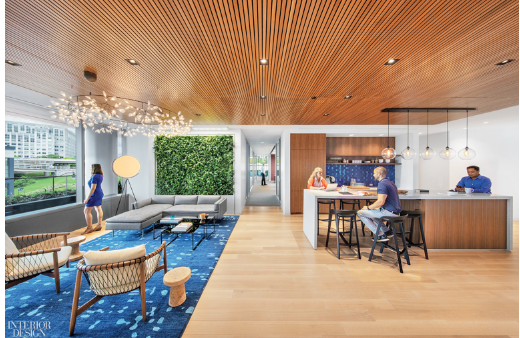
Just as psychotherapists prize intelligent patients, open to the process, architects are delighted when a client “gets it.” So SmithGroup was very happy to discover that the Burgess Group, which specializes in software for Medicare and Medicaid reimbursements, wouldn’t need a remedial design tutorial. In an early meeting to discuss the company’s future headquarters in Alexandria, Virginia, associate Rob Moylan spied the Isamu Noguchi and Eero Saarinen furniture collected by Greg Burgess-and got a good feeling.

  • Lutron Donates Collection to Smithsonian
    5/7/10
    Few inventors can say they revolutionized interior lighting, cut energy consumption, and made people look and feel sexier—all with a single device.  Joel Spira can.
  • Strong Suit
    6/1/2009
    A lot has changed since 2004, when DLA Piper hired Lehman Smith McLeish to personalize a spec building going up on a parking lot in the Penn Quarter in Washington, D.C. As the desolate neighborhood blossomed into a vibrant mixed-use hub, DLA Piper morphed, after multiple mergers, into one of the largest law firms on the planet. Leaving behind a tired 1980′s office, the expanded firm seized upon the 230,000-square-foot space to forge a new identity and work paradigm.
    >> Slide Show
  • Unconventional Wisdom
    3/1/2009
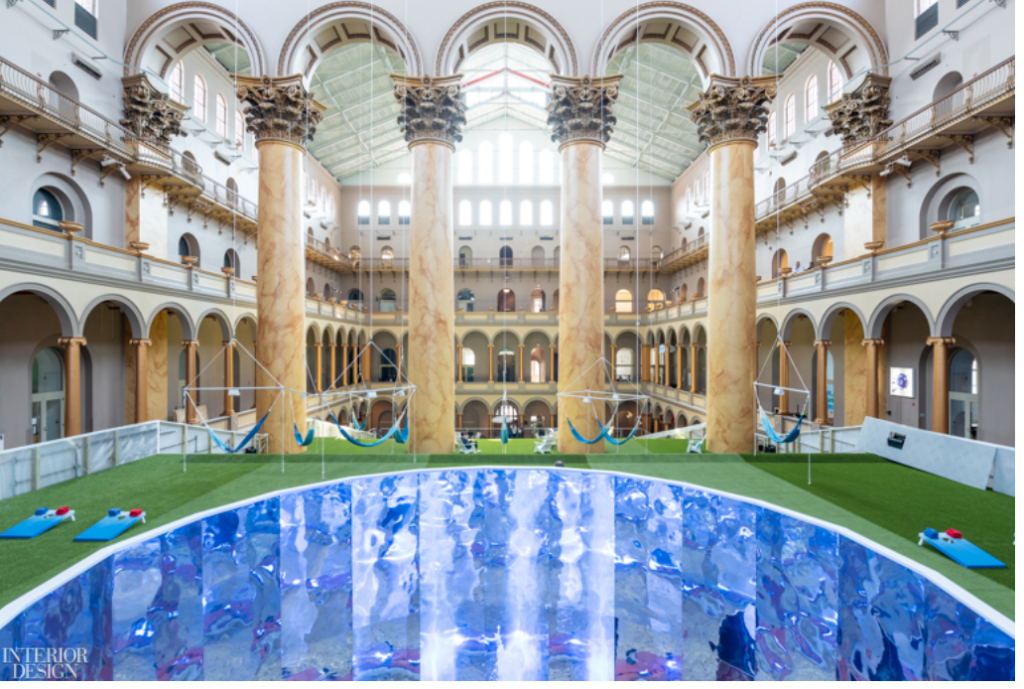
    Alfred Zollinger and Sandra Wheeler have a reputation for not taking things at face value. Designing “Ecotopia: The Second ICP Triennial of Photography and Video” at New York’s International Center of Photography, the husband-wife partners poked fun at environmental orthodoxy by constructing giant Ecotopiaries. The pair’s displays for “Green Community,” now at the National Building Museum in Washington, D.C., are not only technically innovative but also indicative of an increasing involvement in content.
  • Ob-la-di, Ob-la-da
    2/1/2009
    Song and dance or exact science? The guru behind the Beatles lives on through interiors.
  • The Ultimate Insider
    10/1/2009
    Since its inception in 1994, the U.S. General Services Administration’s Design Excellence program has been the single greatest boon to federal architecture. At least for exteriors. For the most part, interiors have been, shall we say, less of a priority. That’s changing—thanks to the country’s Chief Architect Les Shepherd.
  • Time for the Meeting
    Can high-tech and high-style coexist in the conference room?
    5/1/2009

    Time for the Meeting
  • Chalk It Up to Imagination
    5/1/2009
    Although the dot-com generation equates cube-farm openness with no-holds-barred entrepreneurial spirit, that was never Blackboard’s style. Hickok Cole Architects transformed 112,000 square feet in a granite-faced 1980′s office building into a space that promotes Blackboard’s brand in every detail – with plenty of private office space.

    Chalk It Up to Imagination

    >> Slideshow

  • The Modern Mandate
    1/1/2009
    With money tight and ice caps melting, preservation and sustainability experts have linked arms in proclaiming that the greenest building is one that’s already built. Not a moment too soon for the General Services Administration’s postwar properties, which are fast reaching the end of their service life. The GSA’s typical glass-box structures lose up to 70 percent of their energy through leaky curtain walls alone.
  • A Designer’s Best Friend
    9/1/2008
    For a 68-unit luxury condo by Ismael Leyva Architects, the Big Idea was about a classic reinventing itself. So real estate developer Veronica Hackett called Baccarat: “What are you working on in the U.S.? Is it just Philippe Starck, or are you interested in other projects?” In no time, she’d paired the venerable manufacturer with Interior Design Hall of Fame member Vicente Wolf, who incorporated Baccarat crystals into a stunning sculpture for the lobby.

    A Designer’s Best Friend
  • From Bauhaus to Bow-Wows
    10/1/2008
    The most indispensable member of a design studio may have a tail and four paws

    From Bauhaus to Bow-Wows
  • The Big D is for Design
    5/1/2008
    The first of three buildings to anchor the eastern edge of the burgeoning Dallas Arts District, 1 Arts Plaza is a 24-story mixed-used structure by Morrison Seifert Murphy. Clad mostly in a white grid of precast concrete, the asymmetrically massed block is restrained by Dallas standards, exemplifying a new aesthetic in motion.
  • The Alpha Dog
    3/1/2008
    Kenneth Wampler’s Alpha Workshops reinvents lives by providing decorative-arts training to people living with HIV/AIDS.
  • Tex/Zen
    10/1/2007
    Andersson-Wise reinvents a 1980′s house in Austin as a serene haven for art.
  • LEED By Example
    6/1/07
    If schadenfreude were biofuel, Washington, D.C., could crank out enough energy to power the national grid. Executives at the U.S. Green Building Council knew from its inception in 1993 that they needed a national headquarters that walked the walk of the USGBC’s own Leadership in Energy and Environmental Design rating system, the benchmark for green buildings and interiors.
  • Libraries Unbound
    5/1/2007
    Far from becoming obsolete in the high-tech age, libraries are reinventing themselves as places where information is created and exchanged, not just stored and retrieved. In turn, designers are making library interiors more nimble and transparent.
  • Sergio Palleroni
    12/1/2006
    Thanks to a confluence of socioeconomic and ecological crises and the advent of new technologies and construction strategies, the unglamorous though gratifying work of sustainable humanitarian design is making a global impact far beyond the disadvantaged populations immediately served, and Sergio Palleroni is leading the way.
  • Let the Numbers do the Talking
    11/1/2006
    After 65 years in two brick buildings, five miles apart from each other, as well as a couple of satellite offices, the U.S. Census Bureau was due for its own population shift—to consolidate 6,000 of the bureau’s employees into a LEED Silver 2.5 million square feet of office space in Suitland, Maryland, by Skidmore, Owings & Merrill. But what fun would a project be without government constraints?
  • Clear As Crystal
    10/1/2006
    With its office and apartment towers and underground malls, Crystal City was considered avant-garde when it sprang up in the 1960′s amid the brownfields of Northern Virginia. Here was the urban village of the future, where people could live, work, and shop without ever, God forbid, having to go outside. Today, this cliché of urban sterility has again become a hub of forward thinking, with pedestrian esplanades, street-level stores and restaurants, and a new generation of occupants. Among the newcomers is an office by Envision. Registered in the LEED program for commercial interiors, this is the new headquarters of National Datacast.
  • Street Modern
    8/1/2006
    After 13 years among the policy wonks and lobbyists in downtown Washington, D.C., Lehman Smith McLeish headed west, to Georgetown. The move was not only a testament to the architects’ success but also proof that D.C. is no longer such a bastion of stodginess. (Which is saying a lot.)
  • Gimme Shelter
    1/1/06
    When disaster strikes, humanitarian design comes to the rescue.
  • Edward A. Feiner
    12/1/04
    A profile of the chief architect of the U.S., whose Design Excellence program has produced some of the federal government’s most progressive design in a century, from courthouses to high-tech labs.
  • Aspiration Inspiration
    12/1/04
    An interview with inventor James Dyson, who decries “empty styling” and insists that people “want the design process explained to them.”
  • Long-Haul Flight
    11/1/04
    In the works for 14 years, the National Air and Space Museum’s Udvar-Hazy Center is definitely worth the wait.
  • Flushed with Success
    10/1/04
    Water-guzzling toilets give way to eco-friendly models, which are more efficient and eliminate the problem of “fossilized residue.”


HGTV Remodels


8/2011

This comprehensive package comprises about 25 articles and worksheets to help homeowners get started on transforming their yards. Each article is a primer that covers an essential aspect of landscape planning, from assessing topography and creating a conceptual master plan to making smart choices about hardscape, lighting, and contractors.

August 2011

Converting your house to solar energy increases the value of your home by roughly 3.5 percent, according the National Bureau of Economic Research. But what if you live in a neighborhood with strict HOA covenants? Or you’re worried about voiding your roof warranty by attaching something to it? Or you simply don’t like the look of bulky panels and mounting racks on your roof?

August 2011

Living with her four teenage sons in a large 1951 Southern California rambler, Mindy Curtis dreaded her electric bill, which some months ran as high as $1,700. ”Teenage boys do not turn lights off no matter how much you yell at them,” Curtis says. “Their idea of air conditioning is cranking it down to 65 degrees.” Then in 2009, two of her sons — one a science buff, the other an environmentalist — urged her to go solar.


In 1969, Bolton Square, a Baltimore townhouse enclave designed by Hugh Newell Jacobsen, received an Honor Award from the American Institute of Architects, which said the Modernist complex demonstrated “what thoughtful urban design can accomplish.” Forty years later, its residents celebrate the smart, efficient, and practical design. Two of those residents are Marybeth Shaw and Majid Jelveh of the architectural design firm Shaw-Jelveh Design. Says Shaw, “The stability of this complex is a result of the strong design. People need dignity and privacy. They get that here because of the richness of layers and textures and different zones.”

  • The Strongest Link
    April 7, 2005
    An exhibit of objects created by architects, artists, and designers using industrial woven metal mesh demonstrates the versatility and sexiness of a material once reserved for factory conveyor belts.
  • Quick Study columns for the Post’s Home section (2003-2004):
    Taking the Pain Out of Painting
    Getting Good Water at Home — But Not From the Tap
    Shipping News: Getting Furniture and Other Big Things From Here to There
    From California Eastward, Stylish Backyard Campsites Are Catching Fire
    Sounding the Alarm
    Umbrellas: Bigger and Better
    Pillow Talk, More Than Fluff
    Fan Fundamentals
    The Red-Hot Toaster Market
    Papa’s Got a Brand-New Bagless

  • From Attic to Bedroom, With Help from the Web
    2009
    By using online resources to purchase materials, score tools, and even draw up a floor plan, one couple turned a chopped-up attic into a sunny master suite
  • Landmark Lodge
    October 2004
    Perched atop one of the highest peaks in New York’s Catskill Mountains, the house known as “Witchwood” is an evocative reminder of the Gilded Age. With its dark-brown shingles, unpeeled split log siding, and fanciful twig railings, the rambling two-story structure appears to be a perfectly preserved 19th century Adirondack-style lodge. It’s hard to imagine that not long ago the house was sliding into such a state of serious decline that it threatened to fall in on itself.

    A Designer’s Best Friend
  • A Gothic Tale
    May 2004
    Darryl and Kim Cornish used to slow down whenever they drove by “the prettiest house in the country.” They’d drink in the broad veranda, the quirky gingerbread, the tall windows, the sweep of the property– and dream about living in the stately 1850s Carpenter Gothic. When the property just outside Memphis came up for sale, they scraped together the money to buy it. But when their old house failed to sell, the money ran out, and then fire struck. But Darryl had construction know-how and “I’m a real hard worker,” says Kim, so they persevered to save the house and renovate it right.
  • Appalachian Tale
    2003
    When Martha Ann Duncan set out to turn a long-neglected five-room house in the Appalachian Mountains into a weekend retreat, everyone thought she was crazy. The 1906 farmhouse, with its enclosed center breezeway, or dogtrot, had two crumbling porches, peeling clapboards, and a leaky asphalt shingle roof. But when Martha Ann looked at the property she envisioned a country cottage where she could relax with friends by a roaring fire. Never mind that it had no fireplace. She also saw a chance to preserve part of the character of Shady Valley, a picturesque spot 3,000 feet above sea level in northeastern Tennessee. The house had been one of the first homes in the valley to get electricity, in 1942. Old-timers recalled that people would drive by just to see the lightbulb out on the front porch.
  • A Manor Reborn
    Maybe it was the name of the property, Pleasant Fields. Or the idea of roaming its 11 acres on horseback, as generations of previous owner—buried in a family plot in the pasture—had done during its more-than-250-year history. Whatever it was, Donna Marie Seyfried fell in love at first sight with the rundown yet still stately granite house in central Maryland. When her husband, Robert Thomas, saw the 1745 house, however, he was less enthusiastic.
  • Rescuing the Ranch
    June 1999
    I brace myself against the inside of a lurching buckboard pulled by a plodding pair of massive English draft horses. The road is rough, the springs are stiff, my butt hurts, and I can’t believe my luck… heading into the cool hill country of Montana for a week of hard labor
    >> restoring the historic OTO Dude Ranch


  • Open House
    2006
    Architect Nestor Santa-Cruz transforms the Washington, DC, home of Hilary Rosen and Elizabeth Birch

Nature Conservancy

  • Awakenings/Portraits of Faith (cover)
    Spring 2003
    Interviews with conservationists, ecologists, and advocates on how their faith fosters a conservation ethic. The agnostic of the bunch put it best: “What is the right thing to do over and above my personal or selfish concerns?”

Yahoo! Internet Life

  • “God Sitings: Searching for Faith” (cover)
  • “20 Biggest Net Scams and How to Avoid Them” (cover)